Custom Spyglass Hill Golf Club artwork, made to order — a hand-styled map of the course, a painting-style print of your favorite hole, or a finished photo from your round.
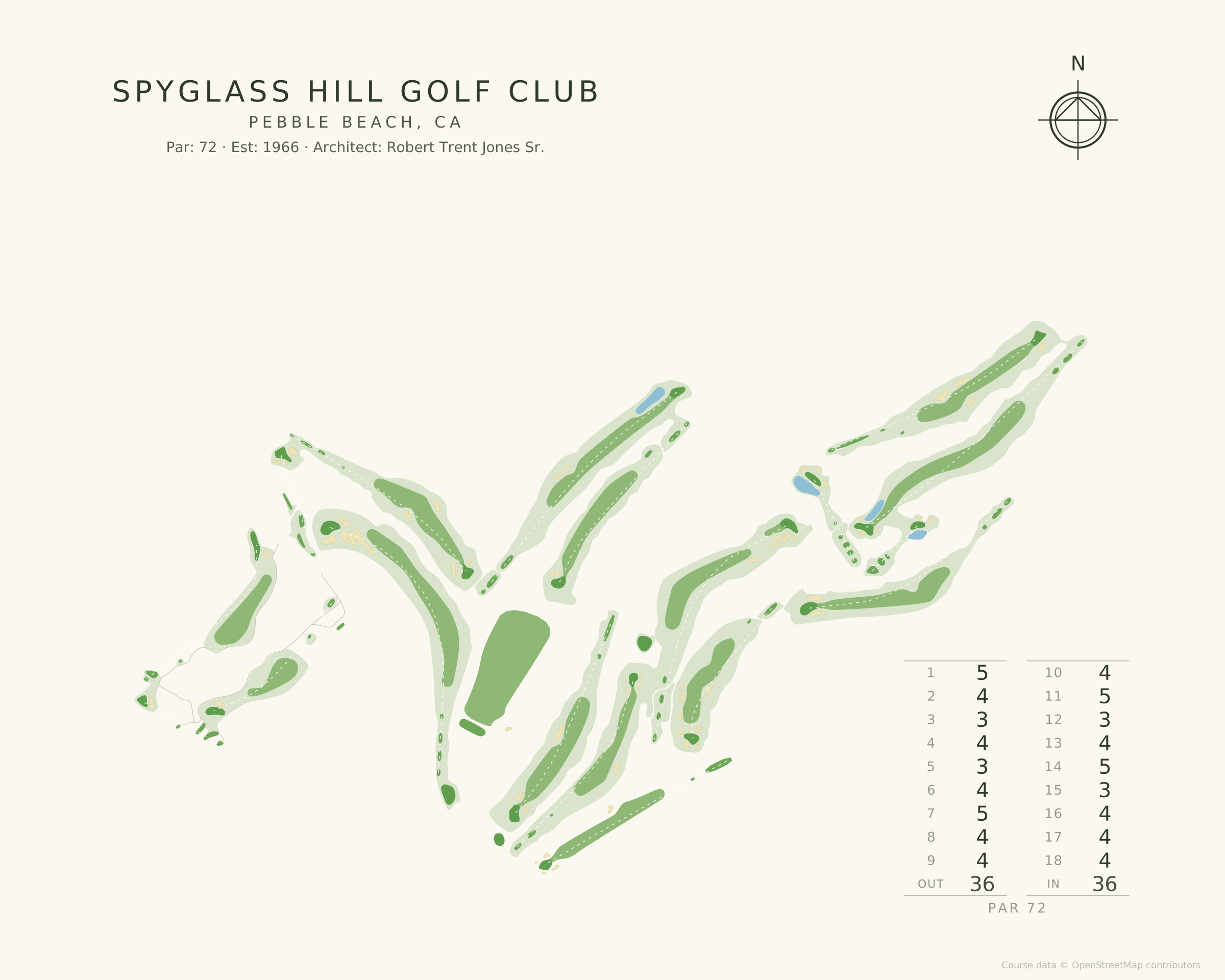
Created from actual data — every tee, fairway, bunker, and green, all in vivid detail.
Robert Louis Stevenson wandered the Monterey Peninsula in 1879, and legend has long held that its wind-bent pines and white dunes helped him imagine Treasure Island. Nearly a century later, Samuel F.B. Morse — the man who built Pebble Beach — took a new Robert Trent Jones Sr. course planned as 'Pebble Beach Pines' and renamed it Spyglass Hill, after the lookout in Stevenson's novel. The Northern California Golf Association's executive director went one better, naming all eighteen holes for the book's characters and places: Treasure Island, Blind Pew, Captain Flint, Long John Silver.
The course that opened on March 11, 1966, after six years of planning and construction, is really two courses in one. The first five holes tumble through open coastal dunes toward the Pacific — as close to links golf as America gets — before the routing turns inland and climbs into the dark corridors of the Del Monte Forest for thirteen holes of tree-lined, uphill, unforgiving parkland. Jones built beauty everywhere and mercy nowhere.
The pros discovered as much in 1967, when Spyglass joined the Bing Crosby Pro-Am rotation — now the AT&T Pebble Beach Pro-Am — where it has terrorized fields nearly every winter since. Crosby himself bet Jack Nicklaus five dollars he couldn't break par his first time around; Nicklaus shot 70 and kept the framed fiver. Sportswriter Jim Murray called Spyglass 'a 300-acre unplayable lie,' and wrote that if the course were human it would have a knife in its teeth, a patch on its eye, and a ring in its ear. He also admitted he loved every unplayable inch of it.
That is Spyglass's peculiar place in golfers' hearts. It has no ocean-wall 18th, no postcard tee shot everyone knows — just eighteen relentless holes that players from Nicklaus onward have called one of the hardest tests in the game. At Pebble Beach you keep the scorecard to remember the views. At Spyglass, you keep it as proof.

Museum-quality Spyglass Hill map art, traced from real course data — every dune, pine corridor, and Treasure Island hole. Four designs, six sizes, or personalized with your own round photo.
Course data © OpenStreetMap contributors (ODbL)